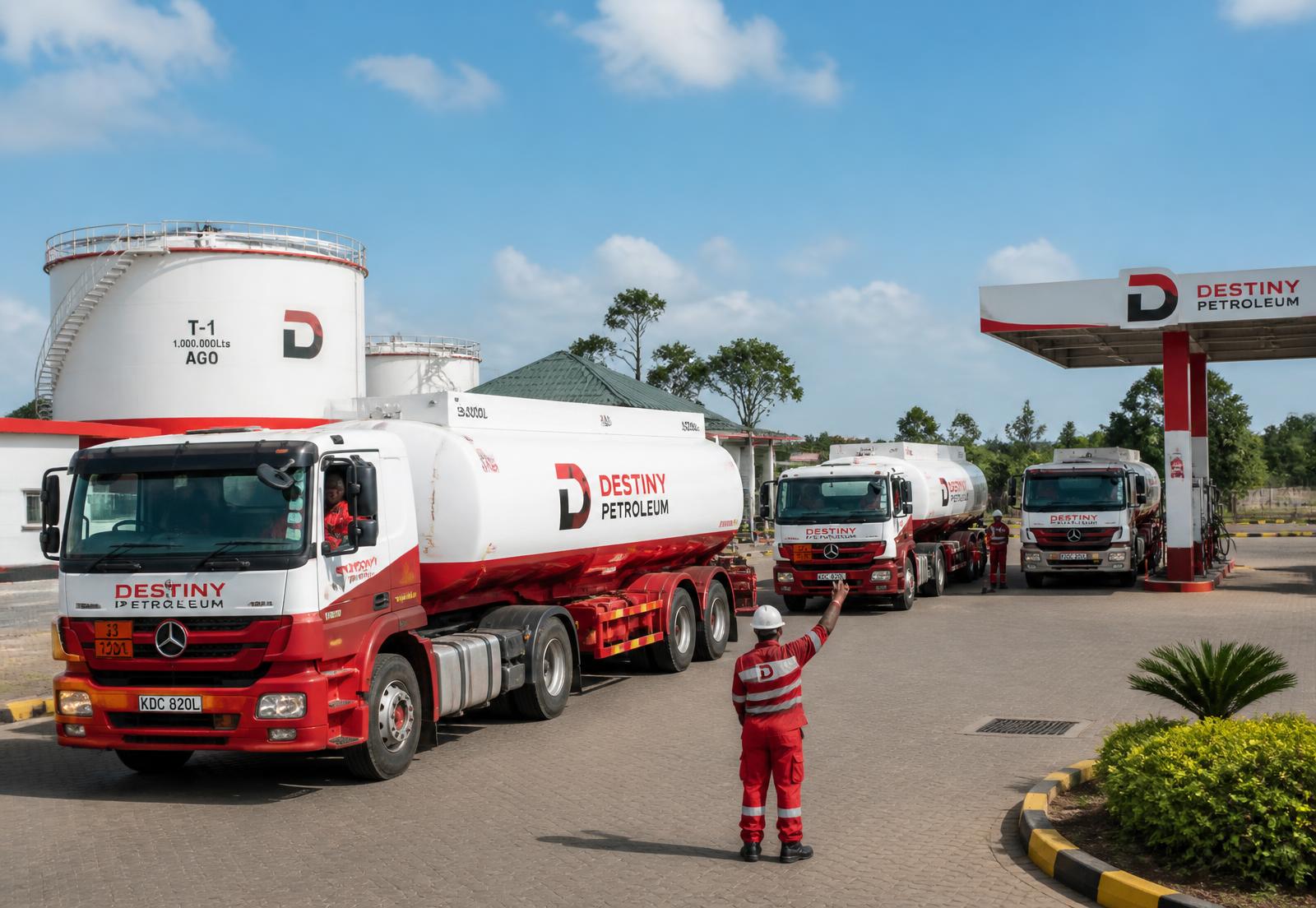
Petroleum Supply in the Democratic Republic of Congo
Fuel supply for mining, industry, transport and power generation across a vast, corridor-dependent market.
Market overview
The Democratic Republic of Congo is one of the most demanding petroleum logistics environments in Sub-Saharan Africa: long inland distances, corridor dependency and highly concentrated industrial demand in the mining provinces.
Destiny Petroleum approaches the DRC as a priority target market, structuring supply around strategic partners, partner infrastructure and planned, verifiable delivery programmes rather than opportunistic cargoes.
Market observations below are qualitative and illustrative, based on publicly discussed regional dynamics. They are not forecasts, guarantees or confirmed volumes.
Demand and supply
Demand
Mining consumption
Copper and cobalt operations in the south-east are structurally diesel-intensive: extraction fleets, haulage, processing and site power.
Power generation
Grid limitations push industrial and commercial sites toward generator sets, creating steady demand for diesel and lubricant supply.
Transport corridors
Long-haul trucking, construction and logistics operators consume fuel along the corridors linking mining regions to ports.
Urban and retail
Rapid urban growth sustains retail and commercial demand for gasoline, diesel and LPG in the main cities.
Supply and constraints
Import dependency
Refined products are largely imported, so pricing and availability track international product markets and freight.
Corridor constraints
Inland delivery depends on road corridors and border processes; transit time is a real cost component, not a detail.
Storage positioning
Reliability depends on where product is held. Storage positioned near consumption reduces exposure to corridor disruption.
Counterparty discipline
Fragmented intermediation makes counterparty screening and documentation quality decisive.
Our solution for DR Congo
Structured sourcing
Product sourced through strategic partners and an international network, with terms built around the buyer's delivery window.
Corridor planning
Route, border and delivery planning with partner fleets, including contingency routing where corridors are exposed.
Stock positioning
Use of partner storage close to consumption points so supply continuity does not depend on a single movement.
Contract transparency
Clear specifications, quantities, documentation and escalation contacts before any commitment is made.
Mining fuel supply in the DRC
Mining sites cannot tolerate supply gaps: an interrupted fuel programme stops haulage, processing and site power at once. Our DRC proposition is built specifically for that constraint.
Site diesel programmes
Planned diesel volumes aligned with production schedules, site tank capacity and consumption rates rather than spot requests.
Generator fuel continuity
Supply planning for on-site power, with buffer stock logic to absorb corridor delays.
Lubricants and specialties
Coordinated supply of lubricants and related products alongside fuel, through strategic partners.
Mine-site delivery
Delivery scheduling to site gates with partner fleets, documentation and quantity verification at each step.
Contractor supply
Supply programmes for drilling, earthmoving and haulage contractors operating around the mining concessions.
Quality assurance
Product specification checks and documented handover to protect equipment warranties and site safety.
Other markets
Zambia
Landlocked supply planning for the Copperbelt, transport operators and commercial consumers.
Target marketTanzania
Coastal entry point and inland gateway for East and Central African supply programmes.
Target marketKenya
A commercially mature East African market with strong inland distribution requirements.
Target marketUganda
Landlocked demand growth driven by transport, construction and energy projects.
Target marketRwanda
A compact, service-sensitive market where delivery precision matters more than volume.
Target marketMalawi
Landlocked corridor supply for transport, agriculture and commercial consumers.
Target marketMozambique
Coastal entry point and corridor gateway for Southern African supply programmes.
Target marketSouth Africa
A mature, competitive market where reliability and documentation differentiate suppliers.
Contact Destiny Petroleum
Start a conversation about supply, logistics, commercial cooperation or a strategic partnership.